در آموزشهای قبلی مجله فرادرس، با مشتق توابع مثلثاتی آشنا شدیم. در این آموزش با تمرکز بیشتری درباره مشتق cotx بحث میکنیم و مثالهای متنوعی را حل خواهیم کرد.
فرمول محاسبه مشتق cotx
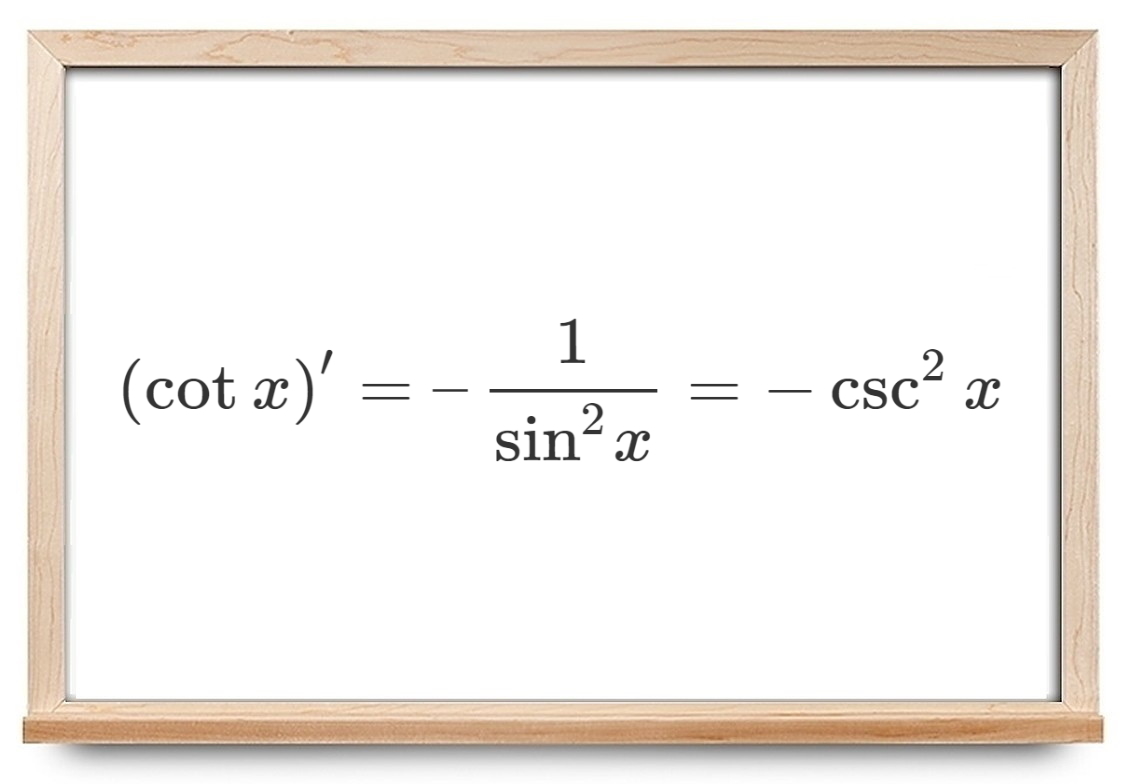
فرمول محاسبه مشتق cotx به صورت زیر است:
$$ \large \begin {align*} \require {cancel} { \left ( { \cot x } \right ) ^ \prime } = { – \frac { 1 } { { { { \sin } ^ 2 } x } } } = - \csc ^ 2 x \end {align*}. $$
اثبات فرمول محاسبه مشتق cotx
اتحادی که سه تابع sin x \sin x sin x cos x \cos x cos x cot x \cot x cot x
cot x = cos x sin x \large \cot x = \dfrac { \cos x } { \sin x } cot x = sin x cos x
اکنون از قاعده خارج قسمت برای مشتقگیری استفاده میکنیم:
d d x cot x = d d x ( cos x sin x ) = ( d d x cos x ) sin x − cos x ( d d x sin x ) sin 2 x \large { \dfrac { d } { d x } \cot x = \dfrac { d } { d x } ( \dfrac { \cos x } { \sin x } ) = \dfrac { { ( \dfrac { d } { d x } \cos x ) } { \sin x } - \cos x ( \dfrac { d } { d x } \sin x ) }{ \sin ^ 2 x } } d x d cot x = d x d ( sin x cos x ) = sin 2 x ( d x d cos x ) sin x − cos x ( d x d sin x )
حال، از دو فرمول d d x cos x = − sin x \dfrac {d}{dx}\cos x = - \sin x d x d cos x = − sin x d d x sin x = cos x \dfrac {d}{dx}\sin x = \cos x d x d sin x = cos x
d d x cot x = − sin x sin x − cos x cos x sin 2 x \large { \dfrac { d } { d x } \cot x = \dfrac { { - \sin x \sin x } - \cos x \cos x } { \sin ^ 2 x } } d x d cot x = sin 2 x − sin x sin x − cos x cos x
و با سادهسازی، داریم:
= − sin 2 x + cos 2 x sin 2 x = − 1 sin 2 x = − csc 2 x \large { = - \dfrac { \sin ^ 2 x + \cos ^ 2 x } { \sin ^ 2 x } = - \dfrac { 1 } { \sin ^ 2 x } = - \csc ^ 2 x } = − sin 2 x sin 2 x + cos 2 x = − sin 2 x 1 = − csc 2 x
البته، یک راه دیگر محاسبه مشتق cotx استفاده از مشتق تابع تانژانت و قاعده زنجیرهای است:
$$ \large \begin {align*} \require {cancel} { \left ( { \cot x } \right ) ^ \prime } & = \left ( { \frac { 1 } { { \tan x } } } \right ) ^ \prime = { – \frac { 1 } { { { { \tan } ^ 2 } x } } \cdot { \left ( { \tan x } \right ) ^ \prime } } \\ & = { – \frac { 1 } { { \frac { { { { \sin } ^ 2 } x } } { { { { \cos } ^ 2 } x } } } } \cdot \frac { 1 } { { { { \cos } ^ 2 } x } } } = { – \frac { \cancel { { { \cos } ^ 2 } x } }{ { { { \sin } ^ 2 } x \cdot \cancel { { { \cos } ^ 2 } x } } } } = { – \frac { 1 } { { { { \sin } ^ 2 } x } }. } \end {align*} $$
فرمول محاسبه مشتق cotu
اما اگر مشتق cotu را به جای مشتق cotx داشته باشیم که u خود یک تابع است، میتوانیم از قاعده زنجیرهای برای مشتقگیری استفاده کنیم:
d d x cot ( u ( x ) ) = ( d d u cot u ) ( d d x u ) \large \dfrac { d } { d x } \cot ( u ( x ) ) = ( \dfrac { d } { d u } \cot u ) ( \dfrac { d } { d x } u ) d x d cot ( u ( x )) = ( d u d cot u ) ( d x d u )
و با سادهسازی خواهیم داشت:
= − csc 2 u d d x u \large = - \csc ^ 2 u \dfrac { d } { d x } u = − csc 2 u d x d u
مثالهای محاسبه مشتق cotx
در این بخش، مثالهایی از محاسبه مشتق cotx و cotu را حل میکنیم.
مثال 1 مشتق cotx
مشتق تابع زیر را محاسبه کنید.
f ( x ) = cot ( x 3 − 2 x + 2 ) \large f ( x ) = \cot ( x ^ 3 - 2 x + 2 ) f ( x ) = cot ( x 3 − 2 x + 2 )
حل: تابع u ( x ) = x 3 − 2 x + 2 u(x) = x^3-2x+2 u ( x ) = x 3 − 2 x + 2 d d x u = d d x ( x 3 − 2 x + 2 ) = 3 x 2 − 2 \dfrac{d}{dx} u = \dfrac{d}{dx} (x^3-2x+2) = 3x^2-2 d x d u = d x d ( x 3 − 2 x + 2 ) = 3 x 2 − 2
d d x f ( x ) = − csc 2 u d d x u = − csc 2 ( x 3 − 2 x + 2 ) × ( 3 x 2 − 2 ) = − ( 3 x 2 − 2 ) csc 2 ( x 3 − 2 x + 2 ) \large \begin {align*} \dfrac { d } { d x } f ( x ) & = - \csc ^ 2 u \dfrac { d } { d x } u = - \csc ^ 2 ( x ^ 3 - 2 x + 2 ) \times ( 3 x ^ 2 - 2 ) \\ & = - ( 3 x ^ 2 - 2 ) \csc ^ 2 ( x ^ 3 - 2 x + 2 ) \end {align*} d x d f ( x ) = − csc 2 u d x d u = − csc 2 ( x 3 − 2 x + 2 ) × ( 3 x 2 − 2 ) = − ( 3 x 2 − 2 ) csc 2 ( x 3 − 2 x + 2 )
مثال 2 مشتق cotx
مشتق تابع زیر را محاسبه کنید.
g ( x ) = cot ( e x ) \large g(x) = \cot (e^x) g ( x ) = cot ( e x )
حل: با در نظر گرفتن u ( x ) = e x u(x) = e^x u ( x ) = e x d d x u = d d x e x = e x \dfrac { d } { d x } u = \dfrac { d } { d x } e ^ x = e ^ x d x d u = d x d e x = e x
d d x g ( x ) = − csc 2 u d d x u = − csc 2 ( e x ) × e x = − e x csc 2 ( e x ) \large \dfrac { d } { d x } g ( x ) = - \csc ^ 2 u \dfrac { d }{ d x } u = - \csc ^ 2 ( e ^ x ) \times e ^ x = - e ^ x \csc ^ 2 ( e ^ x ) d x d g ( x ) = − csc 2 u d x d u = − csc 2 ( e x ) × e x = − e x csc 2 ( e x )
مثال 3 مشتق cotx
مشتق تابع زیر را به دست آورید.
h ( x ) = cot ( − 2 x 3 + 2 ) \large h ( x ) = \cot ( \dfrac { - 2 } { x ^ 3 + 2 } ) h ( x ) = cot ( x 3 + 2 − 2 )
حل: تابع u ( x ) = − 2 x 3 + 2 u(x) = \dfrac{-2}{x^3+2} u ( x ) = x 3 + 2 − 2 d d x u = 6 x 2 ( x 3 + 2 ) 2 \dfrac{d}{dx} u = \dfrac{6x^2}{\left(x^3+2\right)^2} d x d u = ( x 3 + 2 ) 2 6 x 2
d d x h ( x ) = − csc 2 u d d x u = − csc 2 ( − 2 x 3 + 2 ) × 6 x 2 ( x 3 + 2 ) 2 = − 6 x 2 ( x 3 + 2 ) 2 csc 2 ( − 2 x 3 + 2 ) = − 6 x 2 ( x 3 + 2 ) 2 csc 2 ( 2 x 3 + 2 ) \large \begin {align*} \dfrac { d } { d x } h ( x ) & = - \csc ^ 2 u \dfrac { d } { d x } u = - \csc ^ 2 ( \dfrac { - 2 } { x ^ 3 + 2 } ) \times \dfrac { 6 x ^ 2 } { \left ( x ^ 3 + 2 \right ) ^ 2 } \\ & = - \dfrac { 6 x ^ 2 } { \left ( x ^ 3 + 2 \right ) ^ 2 } \csc ^ 2 ( \dfrac { - 2 } { x ^ 3 + 2 } ) = - \dfrac { 6 x ^ 2 } { \left ( x ^ 3 + 2 \right ) ^ 2 } \csc ^ 2 ( \dfrac { 2 } { x ^ 3 + 2 } ) \end {align*} d x d h ( x ) = − csc 2 u d x d u = − csc 2 ( x 3 + 2 − 2 ) × ( x 3 + 2 ) 2 6 x 2 = − ( x 3 + 2 ) 2 6 x 2 csc 2 ( x 3 + 2 − 2 ) = − ( x 3 + 2 ) 2 6 x 2 csc 2 ( x 3 + 2 2 )
مثال 4 مشتق cotx
مشتق عبارت زیر را محاسبه کنید.
y = tan x 2 – cot x 2 \large y = \tan \frac{x}{2} – \cot \frac{x}{2} y = tan 2 x – cot 2 x
حل: در اولین گام، داریم:
y ’ ( x ) = ( tan x 2 – cot x 2 ) ′ = ( tan x 2 ) ′ – ( cot x 2 ) ′ . \large { y’ \left ( x \right ) } = { { \left ( { \tan \frac { x } { 2 } – \cot \frac { x } { 2 } } \right ) ^ \prime } } = { { \left ( { \tan \frac { x } { 2 } } \right ) ^ \prime } – { \left ( { \cot \frac { x } { 2 } } \right ) ^ \prime } . } y ’ ( x ) = ( tan 2 x – cot 2 x ) ′ = ( tan 2 x ) ′ – ( cot 2 x ) ′ .
روابط زیر را میدانیم:
( tan x ) ′ = 1 cos 2 x , ( cot x ) ′ = – 1 sin 2 x , \large { { \left ( { \tan x } \right ) ^ \prime } = \frac { 1 }{ { { { \cos } ^ 2 } x } } , \; \; \; } \kern-0.3pt { { \left ( { \cot x } \right ) ^ \prime } = – \frac { 1 } { { { { \sin } ^ 2 } x } } , } ( tan x ) ′ = cos 2 x 1 , ( cot x ) ′ = – sin 2 x 1 ,
با استفاده از مشتق cotx و قاعده زنجیرهای، میتوانیم بنویسیم:
y ’ ( x ) = 1 cos 2 x 2 ⋅ ( x 2 ) ′ − ( – 1 sin 2 x 2 ) ⋅ ( x 2 ) ′ = 1 cos 2 x 2 ⋅ 1 2 + 1 sin 2 x 2 ⋅ 1 2 = sin 2 x 2 + cos 2 x 2 2 cos 2 x 2 sin 2 x 2 . \large \begin {align*} y’ \left ( x \right ) & = { \frac { 1 } { { { { \cos } ^ 2 } \frac { x } { 2 } } } \cdot { \left ( { \frac { x } { 2 } } \right ) ^ \prime } } - { \left ( { – \frac { 1 } { { { { \sin } ^ 2 } \frac { x } { 2 } } } } \right ) \cdot { \left ( { \frac { x } { 2 } } \right ) ^ \prime } } \\ & = { \frac { 1 } { { { { \cos } ^ 2 } \frac { x } { 2 } } } \cdot \frac { 1 } { 2 } + \frac { 1 } { { { \sin ^ 2 } \frac { x } { 2 } } } \cdot \frac { 1 } { 2 } } = { \frac { { { \sin ^ 2 } \frac { x } { 2 } + { { \cos } ^ 2 } \frac { x } { 2 }} } { { 2 \, { { \cos } ^ 2 } \frac { x } { 2 } { \sin ^ 2 } \frac { x } { 2 } } } . } \end {align*} y ’ ( x ) = cos 2 2 x 1 ⋅ ( 2 x ) ′ − ( – sin 2 2 x 1 ) ⋅ ( 2 x ) ′ = cos 2 2 x 1 ⋅ 2 1 + sin 2 2 x 1 ⋅ 2 1 = 2 cos 2 2 x sin 2 2 x sin 2 2 x + cos 2 2 x .
برای ساده کردن عبارت، از اتحادهای مثلثاتی sin 2 x + cos 2 x = 1 {\sin^2}x + {\cos ^2}x = 1 sin 2 x + cos 2 x = 1 sin x = 2 sin x 2 cos x 2 \sin x = 2\sin {\large\frac{x}{2}\normalsize} \cos {\large\frac{x}{2}\normalsize} sin x = 2 sin 2 x cos 2 x
y ’ ( x ) = 1 2 cos 2 x 2 sin 2 x 2 = 2 ⋅ 1 4 cos 2 x 2 sin 2 x 2 = 2 ( 2 cos x 2 sin x 2 ) 2 = 2 sin 2 x . \large \begin {align*} { y’ \left ( x \right ) } = { \frac { 1 } { { 2 { { \cos } ^ 2 } \frac { x } { 2 } { \sin ^ 2 } \frac { x } { 2 } } } } = { \frac { { 2 \cdot 1 } } { { 4 { { \cos } ^ 2 } \frac { x } { 2 }{ \sin ^ 2 } \frac { x } { 2 } } } } = { \frac { 2 } { { { { \left ( { 2 \cos \frac { x } { 2 } \sin \frac { x } { 2 } } \right ) } ^ 2 } } } } = { \frac { 2 } { { { { \sin } ^ 2 } x } } . } \end {align*} y ’ ( x ) = 2 cos 2 2 x sin 2 2 x 1 = 4 cos 2 2 x sin 2 2 x 2 ⋅ 1 = ( 2 cos 2 x sin 2 x ) 2 2 = sin 2 x 2 .
مثال 5 مشتق cotx
مشتق تابع زیر را به دست آورید.
y = sin 2 x 1 + cot x + cos 2 x 1 + tan x \large y = \frac{{{{\sin }^2}x}}{{1 + \cot x}} + \frac{{{{\cos }^2}x}}{{1 + \tan x}} y = 1 + cot x sin 2 x + 1 + tan x cos 2 x
حل: تابع را برحسب سینوس و کسینوس مینویسیم و ساده میکنیم:
y = sin 2 x 1 + cot x + cos 2 x 1 + tan x = sin 2 x 1 + cos x sin x + cos 2 x 1 + sin x cos x = sin 2 x sin x + cos x sin x + cos 2 x cos x + sin x cos x = sin 3 x sin x + cos x + cos 3 x sin x + cos x = sin 3 x + cos 3 x sin x + cos x . \large \begin {align*} y & = \frac { { { { \sin } ^ 2 } x } } { { 1 + \cot x } } + \frac { { { { \cos } ^ 2 } x } } { { 1 + \tan x } } = { \frac { { { { \sin } ^ 2 } x} } { { 1 + \frac { { \cos x } } { { \sin x } } } } + \frac { { { { \cos } ^ 2 } x } } { { 1 + \frac { { \sin x } } { { \cos x } } } } } \\ & = { \frac { { { { \sin } ^ 2 } x } }{ { \frac { { \sin x + \cos x } } { { \sin x } } } } + \frac { { { { \cos } ^ 2 } x } } { { \frac { { \cos x + \sin x } } { { \cos x } } } } } = { \frac { { { { \sin } ^ 3 } x } } { { \sin x + \cos x } } + \frac { { { { \cos } ^ 3 } x } } { { \sin x + \cos x } } } \\ & = { \frac { { { { \sin } ^ 3 } x + { { \cos } ^ 3 } x } } { { \sin x + \cos x } } . } \end {align*} y = 1 + cot x sin 2 x + 1 + tan x cos 2 x = 1 + s i n x c o s x sin 2 x + 1 + c o s x s i n x cos 2 x = s i n x s i n x + c o s x sin 2 x + c o s x c o s x + s i n x cos 2 x = sin x + cos x sin 3 x + sin x + cos x cos 3 x = sin x + cos x sin 3 x + cos 3 x .
اکنون برای ساده کردن مجدد کسر، از اتحاد زیر استفاده میکنیم:
a 3 + b 3 = ( a + b ) ( a 2 – a b + b 2 ) \large { { a ^ 3 } + { b ^ 3 } } = { \left ( { a + b } \right ) \left ( { { a ^ 2 } – a b + { b ^ 2 } } \right ) } a 3 + b 3 = ( a + b ) ( a 2 – ab + b 2 )
که منجر به عبارت زیر میشود:
y = sin 2 x – sin x cos x + cos 2 x . \large y = {\sin ^2}x – \sin x\cos x + {\cos ^2}x. y = sin 2 x – sin x cos x + cos 2 x .
و در نهایت، جواب مسئله با استفاده از قوانین مشتق cotx و مشتق زنجیرهای و ضرب و با کمک جدول مشتق توابع مثلثاتی پایه به دست میآید:
y ′ = ( sin 2 x ) ′ − ( sin x cos x ) ′ + ( cos 2 x ) ′ = 2 sin cos x − ( sin x ) ′ cos x − sin x ( cos x ) ′ + 2 cos x ( – sin x ) = 2 sin x cos x − cos 2 x + sin 2 x − 2 sin x cos x = – ( cos 2 x – sin 2 x ) = – cos 2 x . \large \begin {align*} y ^ \prime & = \left ( { { { \sin } ^ 2 } x } \right ) ^ \prime - { \left ( { \sin x \cos x } \right ) ^ \prime } + { \left ( { { { \cos } ^ 2 } x } \right ) ^ \prime } \\ & = { 2 \sin \cos x } - { \left ( { \sin x } \right ) ^ \prime \cos x } - { \sin x \left ( { \cos x } \right ) ^ \prime } + { 2 \cos x \left ( { – \sin x } \right ) } \\ & = { \cancel { 2 \sin x \cos x } } - { { \cos ^ 2 } x } + { { \sin ^ 2 } x } - { \cancel { 2 \sin x \cos x } } \\ & = { – \left ( { { { \cos } ^ 2 } x – { { \sin } ^ 2 } x } \right ) } = { – \cos 2 x . } \end {align*} y ′ = ( sin 2 x ) ′ − ( sin x cos x ) ′ + ( cos 2 x ) ′ = 2 sin cos x − ( sin x ) ′ cos x − sin x ( cos x ) ′ + 2 cos x ( – sin x ) = 2 sin x cos x − cos 2 x + sin 2 x − 2 sin x cos x = – ( cos 2 x – sin 2 x ) = – cos 2 x .
مثال 6 مشتق cotx
مشتق تابع زیر را بیابید.
2 cot ( x 2 ) \large 2 \sqrt { \cot ( x ^ 2 ) } 2 cot ( x 2 )
حل: مشتق این تابع به صورت زیر محاسبه میشود:
y ′ = ( 2 cot ( x 2 ) ) ′ = 2 ( cot ( x 2 ) ) ′ = 2 1 2 cot ( x 2 ) ⋅ ( cot ( x 2 ) ) ′ = 1 cot ( x 2 ) ⋅ ( − csc 2 ( x 2 ) ⋅ ( x 2 ) ′ ) = 1 cot ( x 2 ) ⋅ ( − c s c 2 ( x 2 ) ) ⋅ 2 x = − 2 x csc 2 ( x 2 ) cot ( x 2 ) = − 2 x sin 2 ( x 2 ) ⋅ cos ( x 2 ) sin ( x 2 ) = − 2 x sin ( x 2 ) ⋅ sin ( x 2 ) cos ( x 2 ) sin ( x 2 ) = − 2 x sin ( x 2 ) ⋅ sin 2 ( x 2 ) cos ( x 2 ) sin ( x 2 ) = − 2 x sin ( x 2 ) ⋅ cos ( x 2 ) sin ( x 2 ) = − 2 x sin ( x 2 ) ⋅ 2 2 cos ( x 2 ) sin ( x 2 ) = − 2 2 x sin ( x 2 ) ⋅ 2 cos ( x 2 ) sin ( x 2 ) = − 2 2 x sin ( x 2 ) ⋅ sin ( 2 x 2 ) \large \begin {align*} y' & = \left ( 2\sqrt { \cot ( x ^ 2 ) } \right )' = 2 \left ( \sqrt { \cot ( x ^ 2 ) } \right )' = 2 \frac { 1 } { 2 \sqrt { \cot ( x ^ 2 ) } } \cdot \left (\cot (x^2)\right)' \\ & = \frac { 1 } { \sqrt { \cot ( x ^ 2 ) } } \cdot \left ( - \csc ^ 2 (x^2) \cdot (x^2)'\right) = \frac { 1 } { \sqrt { \cot ( x ^ 2 ) } } \cdot \left ( -csc ^2 (x^2)\right ) \cdot 2 x \\ & = \frac {-2x\csc ^ 2 (x^ 2) }{\sqrt { \cot ( x ^ 2 ) } } = \frac {-2x } { \sin ^ 2 ( x ^ 2 ) \cdot \sqrt \frac {\cos (x^2)}{ \sin ( x ^ 2 ) } } = \frac {-2x } { \sin ( x ^ 2 ) \cdot \sin ( x ^ 2 ) \sqrt \frac {\cos (x^2)}{\sin (x^ 2)}} \\ & = \frac {-2x } { \sin ( x ^ 2 ) \cdot \sqrt { \sin ^ 2 ( x ^ 2 ) \frac {\cos (x^2)}{\sin (x^ 2 ) } } } = \frac {-2x } { \sin ( x ^ 2 ) \cdot \sqrt { {\cos (x^2)}{\sin (x^ 2)}}} \\ &= \frac {-2x } { \sin ( x ^ 2 ) \cdot \sqrt {\frac 2 2 {\cos ( x ^ 2 ) } { \sin ( x ^ 2 ) } } } = \frac { - 2 \sqrt 2 x } { \sin ( x ^ 2 ) \cdot \sqrt { 2 { \cos ( x ^ 2 ) } { \sin ( x ^ 2 ) } } } \\ & = \frac { - 2 \sqrt 2 x } { \sin ( x ^ 2 ) \cdot \sqrt { {\sin ( 2x ^ 2 ) } { } } } \end {align*} y ′ = ( 2 cot ( x 2 ) ) ′ = 2 ( cot ( x 2 ) ) ′ = 2 2 cot ( x 2 ) 1 ⋅ ( cot ( x 2 ) ) ′ = cot ( x 2 ) 1 ⋅ ( − csc 2 ( x 2 ) ⋅ ( x 2 ) ′ ) = cot ( x 2 ) 1 ⋅ ( − cs c 2 ( x 2 ) ) ⋅ 2 x = cot ( x 2 ) − 2 x csc 2 ( x 2 ) = sin 2 ( x 2 ) ⋅ s i n ( x 2 ) c o s ( x 2 ) − 2 x = sin ( x 2 ) ⋅ sin ( x 2 ) s i n ( x 2 ) c o s ( x 2 ) − 2 x = sin ( x 2 ) ⋅ sin 2 ( x 2 ) s i n ( x 2 ) c o s ( x 2 ) − 2 x = sin ( x 2 ) ⋅ cos ( x 2 ) sin ( x 2 ) − 2 x = sin ( x 2 ) ⋅ 2 2 cos ( x 2 ) sin ( x 2 ) − 2 x = sin ( x 2 ) ⋅ 2 cos ( x 2 ) sin ( x 2 ) − 2 2 x = sin ( x 2 ) ⋅ sin ( 2 x 2 ) − 2 2 x
مثال 7 مشتق cotx
مشتق ضمنی 3 cot ( x + y ) = cos y 2 3 \cot ( x + y ) = \cos y ^ 2 3 cot ( x + y ) = cos y 2
حل: از تغییر متغیر u = x + y u = x + y u = x + y 3 cot u 3 \cot u 3 cot u
3 ( − csc 2 u ) ( d u d x ) \large { 3 } { \left ( - { { \csc } ^ { 2 } { u } } \right ) }{ \left ( \frac { { { d } { u } } } { { { \left . { d }{ x } \right . } } } \right ) } 3 ( − csc 2 u ) ( d x d u )
مقدار u u u d u d x \frac { d u } { d { x }} d x d u
− 3 csc 2 ( x + y ) ( 1 + d y d x ) \large - { 3 } { { \csc } ^ { 2 } { \left ( { x } + { y } \right ) } } { \left ( { 1 } + \frac { { { \left . { d } { y } \right . } } }{ { { \left . { d } { x } \right . } } } \right ) } − 3 csc 2 ( x + y ) ( 1 + d x d y )
در سمت راست از تغییر متغیر u = y 2 u = y ^ 2 u = y 2 cos u \cos u cos u
( − sin u ) ( d u d x ) \large { \left ( - \sin { { u } } \right ) } { \left ( \frac { { { d } { u } } } { { { \left . { d } { x } \right . } } } \right ) } ( − sin u ) ( d x d u )
با جایگذاری مقدار u u u d u d x \frac { d u } { d x } d x d u
( − sin y 2 ) ( 2 y d y d x ) \large { \left ( - \sin { { y } } ^ { 2 } \right ) } { \left ( { 2 }{ y } \frac { { { \left . { d } { y } \right . } } } { { { \left . { d } { x } \right . } } } \right ) } ( − sin y 2 ) ( 2 y d x d y )
دو طرف را برابر قرار میدهیم:
− 3 csc 2 ( x + y ) ( 1 + d y d x ) = ( − sin y 2 ) ( 2 y d y d x ) \large - { 3 } { { \csc } ^ { 2 } { \left ( { x } + { y } \right ) } } { \left ( { 1 } + \frac { { { \left . { d } { y } \right . } } } { { { \left . { d } { x } \right . } } } \right ) } = { \left ( - \sin { { y } } ^ { 2 } \right ) } { \left ( { 2 } { y } \frac { { { \left . { d } { y } \right . } } } { { { \left . { d } { x } \right . } } } \right ) } − 3 csc 2 ( x + y ) ( 1 + d x d y ) = ( − sin y 2 ) ( 2 y d x d y )
با بسط جملات، میتوان نوشت:
− 3 csc 2 ( x + y ) − 3 csc 2 ( x + y ) d y d x = − 2 y sin y 2 ( d y ) d x \large - { 3 } { { \csc } ^ { 2 } { \left ( { x } + { y } \right ) } } - { 3 } { { \csc } ^ { 2 } { \left ( { x } +{ y } \right ) } } \frac { { { \left . { d } { y } \right . } } } { { { \left . { d }{ x } \right . } } } = - { 2 } { y } \frac { { \sin { { y } } ^ { 2 } { \left ( { \left . { d } { y } \right . } \right ) } } } { { { \left . { d } { x } \right . } } } − 3 csc 2 ( x + y ) − 3 csc 2 ( x + y ) d x d y = − 2 y d x sin y 2 ( d y )
با اضافه کردن 2 y sin y 2 ( d y ) d x { 2 } { y } \frac { { \sin { { y } } ^ { 2 } { \left ( { \left .{ d } { y } \right . } \right ) } } } { { { \left . { d } { x } \right . } } } 2 y d x sin y 2 ( d y )
− 3 csc 2 ( x + y ) − 3 csc 2 ( x + y ) d y d x + 2 y sin y 2 ( d y ) d x = 0 \large - { 3 } { { \csc } ^ { 2 } { \left ( { x } + { y } \right ) } } - { 3 } { { \csc } ^ { 2 } { \left ( { x } +{ y } \right ) } } \frac { { { \left . { d } { y } \right . } } } { { { \left . { d }{ x } \right . } } } + { 2 } { y } \frac { { \sin { { y } } ^ { 2 } { \left ( { \left . { d } { y } \right . } \right ) } } } { { { \left .{ d } { x } \right . } } }= { 0 } − 3 csc 2 ( x + y ) − 3 csc 2 ( x + y ) d x d y + 2 y d x sin y 2 ( d y ) = 0
اکنون 3 csc 2 ( x + y ) { 3 } { { \csc } ^ { 2 } { \left ( { x } + { y } \right ) } } 3 csc 2 ( x + y )
− 3 csc 2 ( x + y ) d y d x + 2 y sin y 2 ( d y ) d x = 3 csc 2 ( x + y ) \large - { 3 } { { \csc } ^ { 2 } { \left ( { x } +{ y } \right ) } } \frac { { { \left . { d } { y } \right . } } } { { { \left . { d } { x } \right . } } } + { 2 } { y } \frac { { \sin { { y } } ^ { 2 } { \left ( { \left . { d } { y } \right . } \right ) } } } { { { \left . { d } { x } \right . } } } = { 3 } { { \csc } ^ { 2 } { \left ( { x } + { y } \right ) } } − 3 csc 2 ( x + y ) d x d y + 2 y d x sin y 2 ( d y ) = 3 csc 2 ( x + y )
از d y / d x dy / dx d y / d x
[ 2 y sin y 2 − 3 csc 2 ( x + y ) ] d y d x = 3 csc 2 ( x + y ) \large { \left [ { 2 } { y } { \sin { { y } } ^ { 2 } - } { 3 }{ { \csc } ^ { 2 } { \left ( { x } + { y } \right ) } } \right ] } \frac { { { \left . { d } { y } \right . } } } { { { \left . { d }{ x } \right . } } } = { 3 } { { \csc } ^ { 2 } { \left ( { x } + { y } \right ) } } [ 2 y sin y 2 − 3 csc 2 ( x + y ) ] d x d y = 3 csc 2 ( x + y )
و در نهایت، جواب به صورت زیر است:
d y d x = 3 csc 2 ( x + y ) 2 y sin y 2 − 3 csc 2 ( x + y ) \large \frac { { { \left . { d } { y } \right . } } } { { { \left .{ d } { x } \right . } } } = \frac { { { 3 } { { \csc } ^ { 2 }{ \left ( { x } + { y } \right ) } } } } { { { 2 } { y } { \sin { { y } } ^ { 2 } } } } - \ { 3 } { { \csc } ^ { 2 } { \left ( { x } + { y } \right ) } } d x d y = 2 y sin y 2 3 csc 2 ( x + y ) − 3 csc 2 ( x + y )